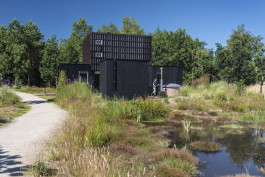
We explored in this project the mutual influence and integration of nature and architecture. Not building on or within the landscape, but with the landscape.
Architectural landscape versus landscape architecture.
This was our main focus when designing the holiday homes in Drenthe, the Netherlands, near Oosterzand. A National Park that is part of Natura 2000, an EU-wide network of nature protection areas. The project was developed in close cooperation with the Nature and Environment Federation Drenthe, the Association for the Preservation of Nature, and the Province of Drenthe. The Province formulated it as a case study: how, in a contemporary and careful manner, recreational architecture can be constructed in sensitive natural areas.
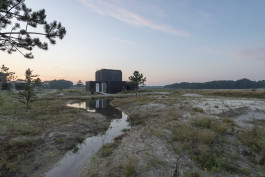
As in a forest where space can arise between trees under the canopy of leaves, we created space by placing four different volumes. In these volumes, different functions are allocated: sleeping, bathing, sitting, and relaxing.
All covered by the green volume of the first floor. The central space, the heart of the house, is formed by the positioning of these four separate volumes: the kitchen, the dining area, and the fireplace. The open space in between creates an extreme connection between inside and outside. This is reinforced with the continuous verandas that link the central space to the surrounding landscape. On the first floor, two double bunk beds are designed which makes the house also suitable for larger groups.

The sustainable houses, ‘nature lodges’, were designed simply. For the facades, native larch was finished with dark coloured Ecoleum. The facade of the first floor will, in the course of time, be covered with vegetation, as a reflection of the surrounding nature.
In the choice of materials, apart from the focus on the ‘ageing’, aesthetic and sensory experience played a role. Smell, sound, reflection of light, texture and transparency were important. For example, small roof openings provide scattered light, like the sun through the canopy of trees.
The houses are extremely isolated, solar panels are placed on the roof, and there is a heat pump system that heats in winter and cools in summer.
The sensitivity of the location and the care conducted during the process in this case study has led to a unique result. Nature reflected.
w/ daad architecten


